
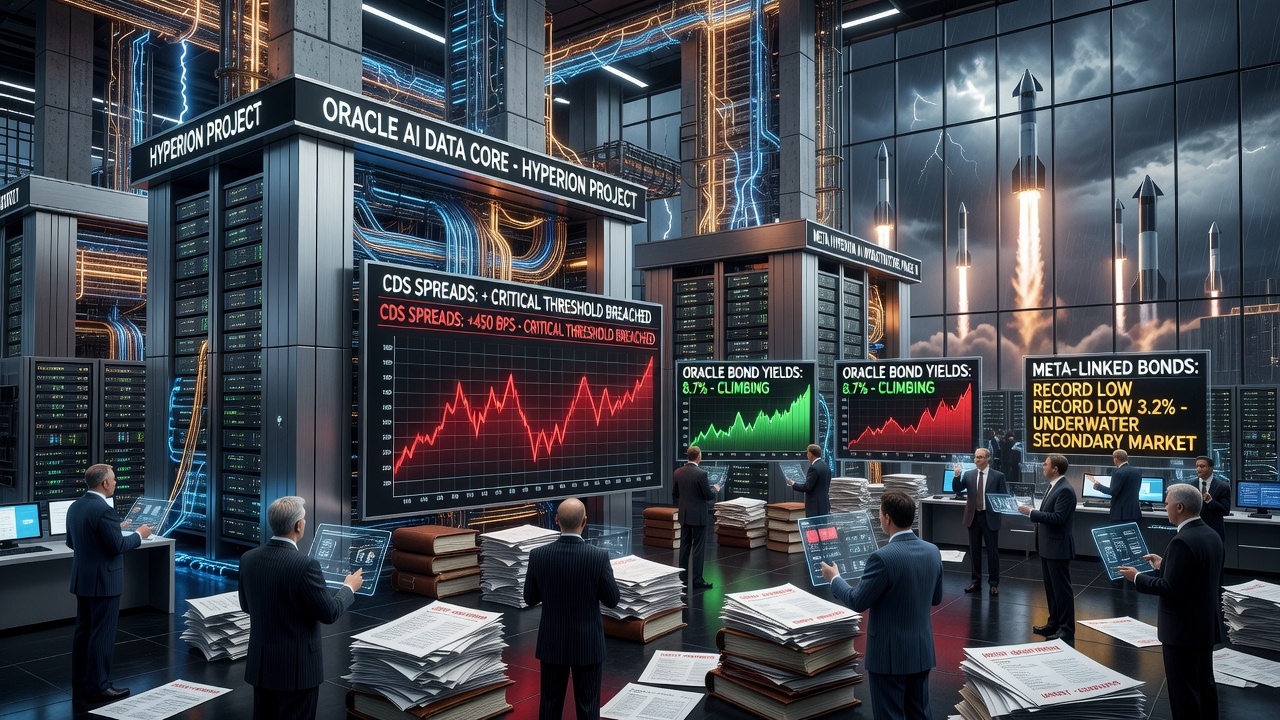
Credit markets are starting to flash warning signs for some of the biggest names in artificial intelligence infrastructure. SpaceX's credit default swap spreads have widened, Oracle bond yields are climbing with its CDS at record highs, and bonds tied to Meta's Hyperion data center project have hit record lows. The pattern suggests that debt already issued to fund the AI buildout is not performing well in the secondary market, even as fresh borrowing keeps coming.
Why Companies Are Turning to Debt
The scale of spending required to build AI capacity - chips, data centers, power infrastructure, computing capacity - has pushed companies toward debt financing rather than relying solely on cash reserves or equity. SpaceX reportedly went to debt markets shortly after a large capital raise, a sequence that signals just how capital-intensive this buildout has become. Oracle and Broadcom have also featured in recent financing conversations tied to AI infrastructure commitments. Borrowing allows companies to move faster than waiting on revenue, but it also means locking in fixed obligations years before the payoff from AI deployment is proven.
What Weakening Bond Performance Signals
A bond that is already underwater in the secondary market is not necessarily a crisis for the issuer - the money has been raised and spent. The bigger problem surfaces when that same company needs to return to the market for more capital. Weak secondary pricing raises the cost of future borrowing and can make investors more cautious about new issuance. SpaceX's situation is a clear example: a company that just completed a major capital event is already testing debt markets again, and investors are pricing in more risk than before.
The underlying question is not whether demand for AI exists - buyers keep showing up for this debt, and capital pulled from other sectors is visibly flowing into the AI trade. The real uncertainty is duration: how long sustained, enormous capital expenditure can continue before cash flow catches up to the debt load. Markets are effectively asking who generates revenue fast enough to service these obligations, and who ends up overextended if adoption slows or timelines stretch.
The Push-Versus-Pull Debate
There is a parallel debate about whether AI infrastructure spending reflects genuine demand or a narrative pushed by sellers of the technology. Many companies using AI tools report real productivity gains, which supports the case for continued investment. At the same time, some of the proposed future use cases - including AI systems designed to monitor or defend against other AI systems - illustrate how the industry is building both the technology and the justification for needing more of it simultaneously. That dynamic does not invalidate the demand story, but it does suggest adoption may prove slower and more uneven than the pace of current infrastructure spending assumes.
Implications for Investors and the Broader Market
For investors, the widening spreads and falling bond prices are an early signal worth watching rather than a definitive verdict on the AI buildout. Debt-financed infrastructure spending only works if revenue growth eventually matches the obligations taken on. If that timeline slips, refinancing becomes more expensive, and companies with the weakest cash flow relative to debt load face the most pressure. The pattern across SpaceX, Oracle, and Meta-linked debt suggests markets are beginning to differentiate between AI enthusiasm and AI execution, a distinction that will matter more as the buildout continues.