
Aztec Priestess and the Sacred Aztec Goddess: Inside Ancient Temples, Rituals, and Mythology
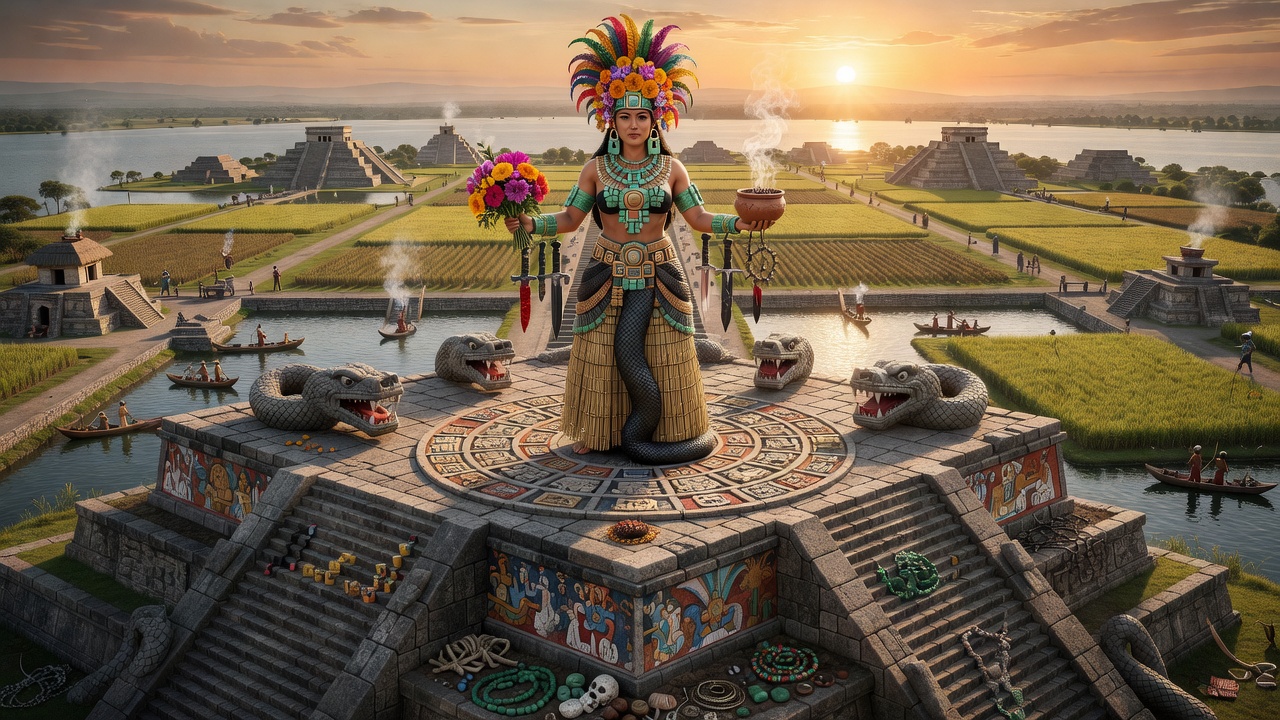
A woman standing atop the Templo Mayor in Tenochtitlan around 1500 CE held more direct spiritual authority than most European clergy of her era. She spoke to deities on behalf of an empire of roughly five million people, oversaw calendars that dictated when crops were planted and wars declared, and trained from childhood for a role that blended theology, astronomy, and statecraft into a single office. This was the Aztec priestess - a figure largely erased from popular memory yet central to how the Aztec world understood itself.
Her counterpart in the divine realm was equally commanding. Every major Aztec goddess governed forces the empire could not survive without: fertility, water, maize, the moon, even the earth's raw creative violence. Understanding these women - mortal and divine - means stepping past the gold masks and stone serpents that dominate museum displays and into the daily mechanics of belief. For readers who encounter this history first through a modern lens, even something as playful as an aztec priestess slot draws directly from these ancient roles, repackaging temple imagery and goddess iconography for a new audience. The real history, though, is stranger and more layered than any game screen could suggest.
This piece walks through who these priestesses actually were, which goddesses commanded their devotion, what happened inside the temple walls, and how ritual practice connected heaven, earth, and empire.
Who Was the Aztec Priestess? Roles, Training, and Daily Life
The Aztec priesthood was not a single uniform class. It was a hierarchy with distinct entry points, specializations, and expectations, and women occupied defined positions within it rather than functioning as occasional exceptions.
Selection and Early Training
Girls entered religious service typically through the calmecac, an elite school attached to temple precincts, though some communities maintained separate institutions for future priestesses. Selection often depended on family status, personal aptitude, or a vow made by parents at a child's birth. Training lasted years and covered ritual song, the 260-day sacred calendar known as the tonalpohualli, herbal medicine, and the physical discipline required for fasting and nighttime vigils.
Duties Within the Temple Hierarchy
A trained Aztec priestess managed offerings, maintained sacred fires that could not be allowed to extinguish, wove ceremonial garments for cult statues, and led female-specific rites tied to agricultural cycles and childbirth. Some rose to senior positions overseeing junior priestesses, effectively running the female religious staff of a temple complex. Others served specific goddesses exclusively, living within temple grounds for set terms rather than permanently.
Restrictions and Social Standing
Celibacy and dietary restriction defined much of a priestess's active service period, though these rules varied by cult and city-state. Breaking vows carried serious consequences, sometimes including exile. In exchange, priestesses gained genuine social respect - families considered a daughter's temple service an honor that elevated the household's standing within the community.
- Entry through calmecac schools tied to family vows or aptitude
- Years of training in calendar systems, ritual language, and herbal knowledge
- Defined hierarchy allowing advancement to senior temple roles
- Strict codes around chastity, diet, and public conduct during service
The Aztec Goddess Pantheon: Power, Fertility, and Fear
Aztec religion organized the cosmos through paired forces - creation and destruction, male and female, sun and earth - and its goddesses embodied the volatile half of that equation. They were rarely gentle figures; fertility and violence sat side by side in their mythology.
Coatlicue: Mother of Gods and Earth Itself
Coatlicue, "Serpent Skirt," represented the earth as both womb and grave. Aztec mythology describes her giving birth to Huitzilopochtli, the war god, after being impregnated by a ball of feathers - a story that framed her as origin point for the empire's patron deity. Her stone imagery, discovered beneath Mexico City, shows a figure wearing a skirt of writhing serpents and a necklace of human hands and hearts, a visual language meant to convey the earth's capacity to consume as readily as it nourishes.
Chalchiuhtlicue and the Power of Water
Chalchiuhtlicue, "She Who Wears a Jade Skirt," governed rivers, lakes, and rainfall. Given Tenochtitlan's location on a lake-bound island connected by causeways, water management was a matter of survival, not abstraction. Her cult influenced flood-control rituals and the naming ceremonies performed for newborns, who were symbolically washed under her protection.
Xochiquetzal and Fertility Rites
Xochiquetzal presided over love, beauty, and craftsmanship, particularly weaving and other female-associated arts. Her festivals involved flower offerings and dance, and she stood in deliberate contrast to the harsher maternal figures like Coatlicue - proof that the Aztec goddess archetype was not monolithic but spanned tenderness and terror within a single religious system.
Ancient Aztec Temple Architecture and Sacred Geography
Temples were not incidental backdrops to ritual - their physical design encoded theology directly into stone.
The Templo Mayor: Center of the Aztec Universe
The Templo Mayor in Tenochtitlan functioned as the literal center point of Aztec cosmology, a dual pyramid dedicated jointly to Huitzilopochtli and Tlaloc, the rain god. Excavations beginning in 1978 uncovered layered construction phases, each ruler adding a new shell atop the old structure, along with buried offering caches containing shells, jade, and sacrificial remains.
Regional Temples and Local Goddess Cults
Beyond the capital, smaller city-states maintained their own temple networks dedicated to local patron deities, many of them goddesses tied to specific springs, mountains, or agricultural zones. These regional shrines allowed a decentralized religious economy where an ancient Aztec temple in a farming community might rival the capital's structures in local importance, even without matching its scale.
Symbolism Built Into Stone
Orientation mattered. Temples aligned with solstice sunrises, mountain peaks, or specific stars, turning architecture into a functioning calendar. Staircases numbering in multiples significant to the ritual calendar, serpent balustrades, and painted murals depicting mythological scenes reinforced the idea that the building itself was a living participant in cosmic order, not a passive container for worship.
Aztec Ritual Practices: Ceremonies, Offerings, and Sacrifice
Ritual in Aztec society operated on the assumption that the universe required constant maintenance through human action. Neglect risked drought, famine, or cosmic collapse.
Calendar-Based Ceremonies
The eighteen-month solar calendar, the xiuhpohualli, structured a near-continuous cycle of festivals. Each month carried its own patron deity, required offerings, and prescribed activities, from harvest celebrations to rites demanding bloodletting. An Aztec priestess often directed the female-specific components of these month-long observances, particularly those tied to maize goddesses and water deities.
Offerings, Bloodletting, and Sacrifice
Sacrifice ranged dramatically in intensity. Everyday devotion involved offerings of flowers, copal incense, food, and personal bloodletting through small cuts to fingers or ears. Large state ceremonies, particularly those tied to war god festivals, involved human sacrifice performed by priests atop temple platforms, framed theologically as necessary payment to keep the sun moving and the earth fertile. These practices, disturbing to modern audiences, made complete sense within a worldview where the gods themselves had sacrificed to create the current world age.
Rites Performed Exclusively by Priestesses
Certain rituals fell entirely to women. Childbirth ceremonies, weaving dedications to Xochiquetzal, and specific harvest rites honoring maize goddess Chicomecoatl required an Aztec priestess rather than a male priest, reflecting a gendered division of sacred labor that mirrored the gendered division of goddesses and gods themselves.
Mythology and Meaning: How Aztec Stories Shaped Ritual and Society
Myth was not entertainment in Aztec culture - it was operating instructions for how to keep the world functioning.
Creation Myths and the Five Suns
Aztec cosmology held that the world had already passed through four previous ages, each destroyed by catastrophe, with the current fifth age sustained precariously through ongoing sacrifice. This narrative directly justified ritual practice: if the gods had given their own blood to set the sun in motion, humans owed a comparable debt.
Goddesses as Moral and Natural Forces
Stories about Coatlicue, Chalchiuhtlicue, and other goddesses did more than explain natural phenomena. They modeled acceptable behavior, warned against excess, and reinforced the idea that fertility and destruction were two faces of a single force rather than opposing principles - a distinctly non-Western moral framework.
Mythology's Afterlife in Modern Culture
These stories never fully disappeared. They surface today in murals, literature, and even entertainment products that borrow temple imagery and goddess symbolism, an Aztec mythology slot theme being one contemporary example of ancient religious iconography finding new cultural life, stripped of its original ritual weight but still carrying recognizable visual DNA from Tenochtitlan's temples.
Legacy of the Aztec Priestess and Goddess Worship Today
Spanish colonization dismantled the formal priesthood by the mid-1500s, burning codices and converting temples into church foundations. Yet the underlying reverence for feminine sacred power did not vanish so completely as colonial records suggest.
Syncretism With Catholic Tradition
Scholars have long noted structural parallels between devotion to certain Aztec goddesses and the rapid, intense adoption of Marian worship in colonial Mexico. Communities that once honored fertility and earth goddesses transferred elements of that devotional energy toward new religious figures, preserving ritual patterns even as official theology changed entirely.
Archaeological Recovery and Public Memory
Ongoing excavation at the Templo Mayor site continues to reveal offering caches and architectural details, feeding both academic understanding and public fascination. Museums in Mexico City now present priestess roles and goddess iconography with far more nuance than earlier twentieth-century displays, which tended to flatten Aztec religion into simple sacrifice narratives.
Cultural Reclamation Movements
Contemporary Indigenous communities in Mexico have revived elements of goddess veneration and calendar-based ceremony, treating this history as living heritage rather than a closed museum subject. This reclamation runs parallel to, and largely separate from, the goddess imagery that appears in unrelated commercial or entertainment contexts.
Frequently Asked Questions
Did Aztec priestesses hold real political power, or was their role purely religious?
Their authority centered on religious and calendrical functions, but because religion and governance were deeply intertwined in Aztec society, senior priestesses influenced decisions about planting schedules, festival timing, and community resource allocation. This gave them practical influence well beyond ceremonial duties alone.
Were all Aztec goddesses associated with fertility?
No. While figures like Xochiquetzal and Chicomecoatl connected directly to fertility and agriculture, others such as Coatlicue represented earth's destructive and generative power together, and Mictecacihuatl governed the underworld itself. The pantheon covered a much wider range of natural and cosmic forces than fertility alone.
How long did priestess training typically last?
Training generally spanned several years, beginning in childhood or early adolescence at institutions like the calmecac. Duration depended on the specific cult and the seniority of role a young woman was preparing for, with senior temple positions requiring longer, more specialized instruction.
What happened to Aztec priestesses after the Spanish conquest?
The formal priesthood collapsed rapidly following conquest, as temples were destroyed and religious practice was suppressed or forced underground. Many former religious practitioners either integrated aspects of their knowledge into folk healing traditions or saw their roles erased entirely from official colonial records.
Is human sacrifice accurately represented in popular depictions of Aztec ritual?
Popular media often exaggerates the frequency and drama of human sacrifice while ignoring the far more common daily rituals involving incense, food offerings, and bloodletting. Sacrifice was real and significant, particularly for state ceremonies, but it existed within a much broader ritual calendar dominated by less dramatic acts of devotion.
Why do modern games and entertainment products use Aztec goddess imagery?
The visual language of Aztec religion - serpents, jade, sun imagery, temple pyramids - carries strong aesthetic and mythological appeal, making it a popular theme for entertainment design. These products typically borrow surface symbolism rather than engaging with the historical or religious complexity behind it.