
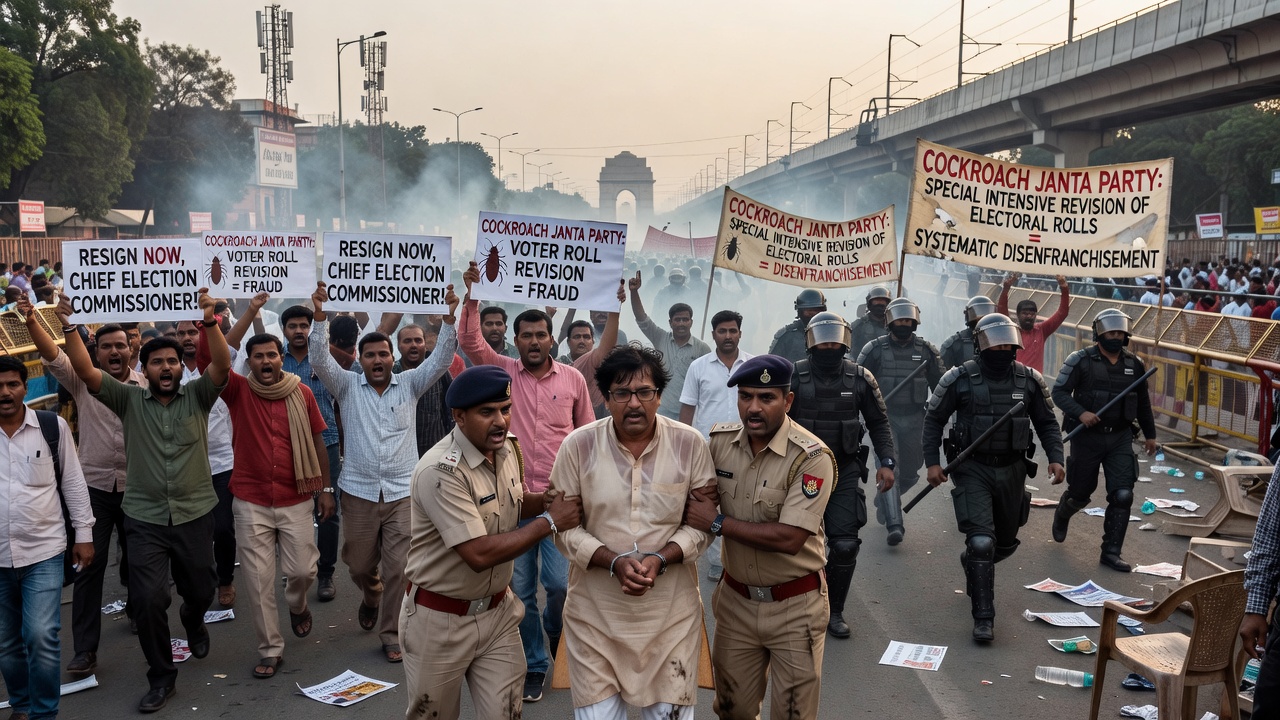
Delhi police detained the founder of the satirical Cockroach Janta Party, Abhijeet Dipke, along with hundreds of other demonstrators, to prevent a planned rally demanding the resignation of India's chief election commissioner. Security forces sealed off parts of the capital, suspending travel links and telecommunications in a lockdown that Amnesty International has called an attempt to create "a climate of fear." The protest centres on a contentious nationwide revision of electoral rolls that critics say has stripped voting rights from millions of Indians.
What the voter list dispute is really about
At the heart of the unrest is the Special Intensive Revision, a process launched last year that requires existing voters to re-prove their eligibility using decades-old documents such as birth certificates, land records or school papers. A small discrepancy - a misspelled name, a mismatched date - can be enough to remove someone from the rolls. Because voting status in India is linked to access to welfare schemes, disenfranchisement carries consequences well beyond the ballot box. Opposition parties and civil society groups argue the burden falls hardest on poorer, migrant and minority communities, with reporting pointing to disproportionate deletions among Muslim voters in states including West Bengal, Bihar, Delhi and Assam. More than 130 million names have reportedly been removed from the rolls, fuelling accusations that the exercise has reshaped electoral outcomes in the ruling BJP's favour. The matter is now before the Supreme Court.
A protest movement born from a judicial insult
The Cockroach Janta Party emerged in May as an online satirical response after India's Chief Justice compared unemployed youth and activists to "cockroaches" and "parasites." What began as mockery evolved into organised street action: a June demonstration over exam system failures, a July march on parliament that drew more than ten thousand participants and ended in clashes with police using tear gas and pellet guns, and ultimately the resignation of the education minister that same month. The group's current campaign, dubbed "Protest 2.0," launched on Gandhi's birth anniversary in October and has spread to Bengaluru and Mumbai, with daily demonstrations and repeated detentions of organisers and allied student groups.
Institutional credibility under strain
The scale of the crackdown - rights groups cite figures above five thousand detentions, including opposition politicians, journalists, lawyers and student leaders - has drawn sharp criticism from press freedom and human rights organisations, who argue that peaceful assembly and expression are constitutionally protected in India regardless of how the government characterises protesters. Government spokespeople have dismissed the demonstrators as "anarchic elements" disconnected from the country's broader stability. Independent election observers, including a former chief election commissioner, describe an institution that once commanded broad public trust now facing what they call a credibility collapse. Whatever the outcome of the Supreme Court challenge, the controversy underscores how administrative processes framed as routine list-cleaning can carry outsized political weight when transparency is contested and enforcement falls unevenly across communities.