
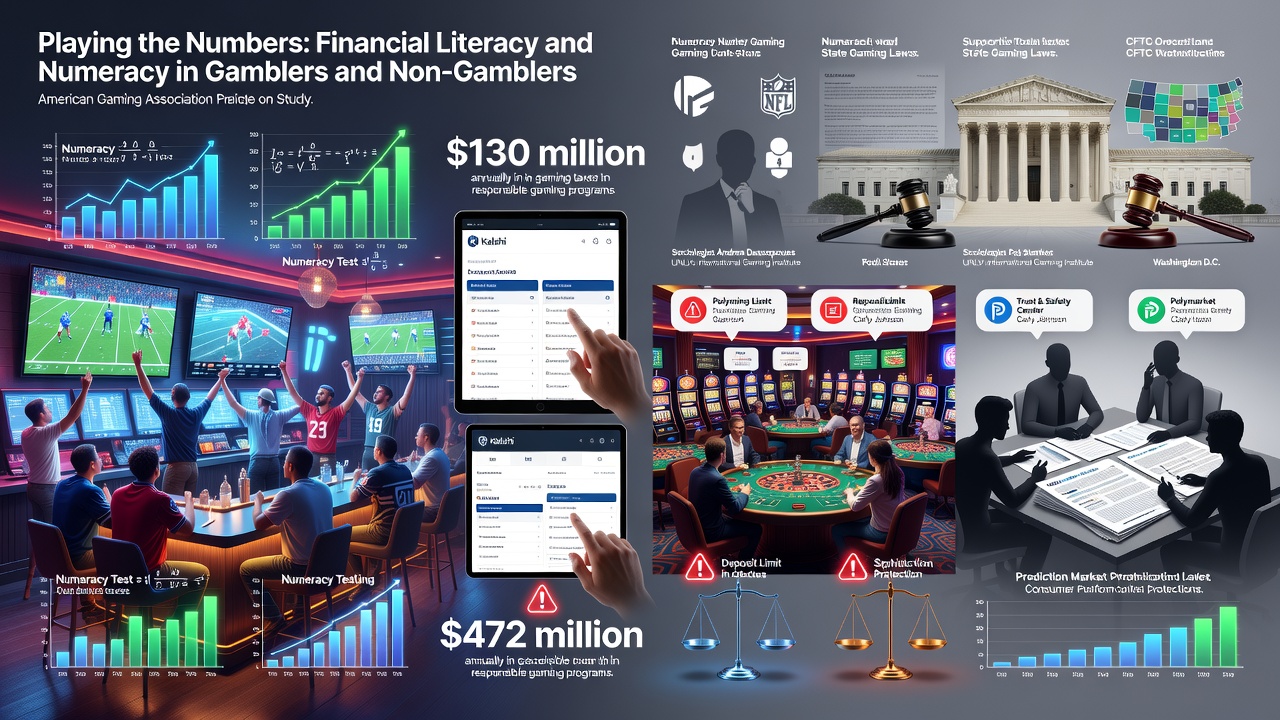
Gamblers scored higher on financial literacy and numeracy tests than people who don't gamble at all, according to new research from the American Gaming Association. The finding, drawn from the report "Playing the Numbers: Financial Literacy and Numeracy in Gamblers and Non-Gamblers," pushes back against a persistent assumption that bettors are financially naive or acting on impulse rather than understanding. The timing matters: the study lands as courts and regulators fight over who gets to oversee a new class of betting-adjacent products known as prediction markets.
Breaking Down the Numbers
Sports bettors posted the strongest results across every category the AGA measured, according to Carly Johnson, the organization's director of research. Casino players, meanwhile, reported the highest scores for what researchers call "positive play" - behavior consistent with responsible gaming, such as setting limits and recognizing warning signs. Johnson pointed to this as evidence that the casino sector's decades of regulatory experience and responsible gaming infrastructure are producing measurable results, not just good intentions.
The study's most pointed finding involves prediction market users, who use platforms like Kalshi and Polymarket to trade contracts on sports, elections and other events. These users expressed confidence in their math skills comparable to sports bettors, but their actual test performance resembled non-gamblers. Johnson described this gap as a consumer protection concern, arguing that prediction markets market themselves as investment vehicles while offering what function, in practice, as sports bets - without the responsible gaming disclosures or tools that licensed sportsbooks must provide.
A Regulatory Fight Over Who Gets to Decide
The financial literacy study arrives alongside an unresolved legal battle over prediction markets' regulatory status. The AGA filed an amicus brief in October backing New Jersey's petition asking the Supreme Court to settle whether states can apply their own gaming laws to platforms like Kalshi, or whether federal oversight by the Commodity Futures Trading Commission preempts state authority entirely.
Federal appeals courts have split on the question. The Third Circuit ruled that Kalshi operates under CFTC jurisdiction, exempting it from New Jersey's gaming statutes. The Ninth Circuit reached the opposite conclusion in a Nevada case, upholding a cease-and-desist order against the company after the state's Gaming Control Board determined it was offering unlicensed sports betting contracts. The NFL and a bipartisan coalition of 39 states plus Washington, D.C., have also filed briefs supporting New Jersey, describing the current legal patchwork as unworkable.
- Licensed gaming operators fund roughly $472 million annually in responsible gaming programs and pay more than $130 million a year in gaming taxes that support problem gambling services, according to the AGA.
- Prediction market platforms are not subject to the same state-level consumer protection requirements, Johnson said.
- Polymarket introduced a Trust & Safety Center in September, adding voluntary self-exclusion, deposit limits and mental health resources.
What Financial Literacy Can and Cannot Explain
Andrea Dassopoulos, a sociologist with UNLV's International Gaming Institute who studies problem gambling and player protection, cautioned against overreading the study's implications. Financial literacy, she said, is "just a piece" of what protects consumers from gambling-related harm, and should be paired with safer product design, deposit limits and other established tools rather than treated as a standalone fix.
She noted an apparent contradiction in the AGA's own data: sports bettors scored highest on financial literacy, yet casino players reported stronger positive play behavior. That gap, she argued, shows that knowledge alone doesn't reliably change behavior. Understanding odds or probability doesn't guarantee someone will act on that understanding when placing a bet. Dassopoulos framed her overall reaction to the report as a call for more research rather than a settled conclusion.
The debate underscores a broader tension facing regulators as new betting-adjacent products proliferate: distinguishing consumer sophistication from consumer protection, and deciding which oversight structures should apply when a product looks like a bet but is marketed as something else.