
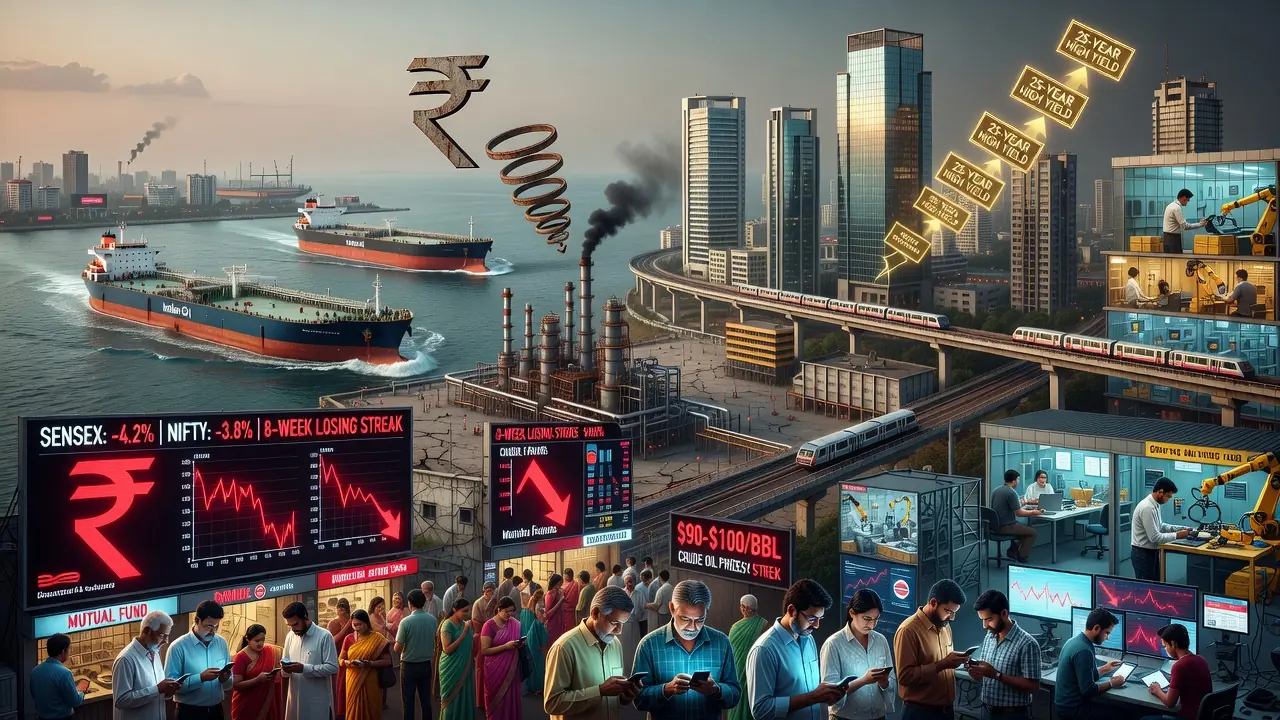
India's economy is expanding at more than 7%, outpacing every other major nation despite energy shocks, elevated interest rates and tariff disputes. Yet its stock market tells a different story: the Sensex and Nifty indices have just ended an eight-week losing streak, the longest in a quarter century, according to Reuters. The disconnect between a thriving economy and a struggling market has left millions of retail investors nursing losses and raised hard questions about what is actually driving capital allocation in emerging markets.
Oil, interest rates and a weaker currency
Crude oil has stayed stubbornly high, with prices sitting between $90 and $100 a barrel as shipping disruptions through the Strait of Hormuz drag on far longer than most analysts expected. India imports the overwhelming majority of its oil, and a large share of that comes through this single corridor, which means sustained disruption feeds directly into inflation, corporate margins and the broader cost of doing business. Fund manager Hari Shyamsunder of Franklin Templeton Asset Management India noted that markets can tolerate crude between $70 and $90, but prices above $100 start to strain macroeconomic variables in ways that show up in both inflation data and company earnings.
Layered on top of this is a global rise in interest rates. With US government bond yields sitting near 25-year highs, capital that might otherwise flow into emerging markets like India is instead gravitating toward what is perceived as a safer, now more rewarding, destination. This dynamic is reinforced by a weaker rupee, which has eroded dollar-denominated returns for foreign investors. Over the past decade, the Nifty has delivered annualised dollar returns of only around 6%, a figure that struggles to compete with alternative markets.
Valuations have cooled but not enough
The two-year correction in Indian equities has narrowed the premium that Indian stocks once commanded over other emerging markets. Shyamsunder points out that valuations are now cheaper than their ten-year average. But cheaper is not the same as cheap. Relative to earnings, Indian stocks remain pricier than peers in markets such as South Korea and Taiwan, where companies have captured outsized profits from the global boom in artificial intelligence.
The missing new-economy engine
This is where the structural gap becomes clearest. India has not produced a globally dominant AI company comparable to OpenAI, Anthropic or China's DeepSeek, and it is in that layer of the value chain where the largest profit pools currently sit. Bernstein Research has argued that many of India's largest listed companies reflect an older economic model, focused on defending existing market positions rather than investing aggressively in new technology. Smaller, more innovative firms in areas such as space, defence, semiconductors and deep-tech are emerging, but most remain too small to shift capital allocation decisions at scale.
The result is a market that foreign institutional investors have largely stepped back from. Bernstein data shows that net foreign investment into Indian equities over the past decade is close to zero once withdrawals are factored in, with roughly $40bn pulled out in the past two years alone.
Retail investors are absorbing the strain
What has kept the market from falling further is domestic money. Mutual fund assets under management in India have grown from roughly $125bn in 2016 to about $900bn today, with the number of individuals investing in stocks and funds more than tripling to 150 million. That is a structural shift in how ordinary Indians save, but it also means household wealth is now directly exposed to equity market volatility at a moment when job growth is weak, inflation is elevated and consumption is already under pressure.
Whether this flow of retail capital continues depends on sentiment holding up through further earnings disappointments or a deeper correction. For a market increasingly underpinned by mom-and-pop investors rather than institutional capital, that resilience - not the headline GDP number - may be the real indicator to watch in the months ahead.