
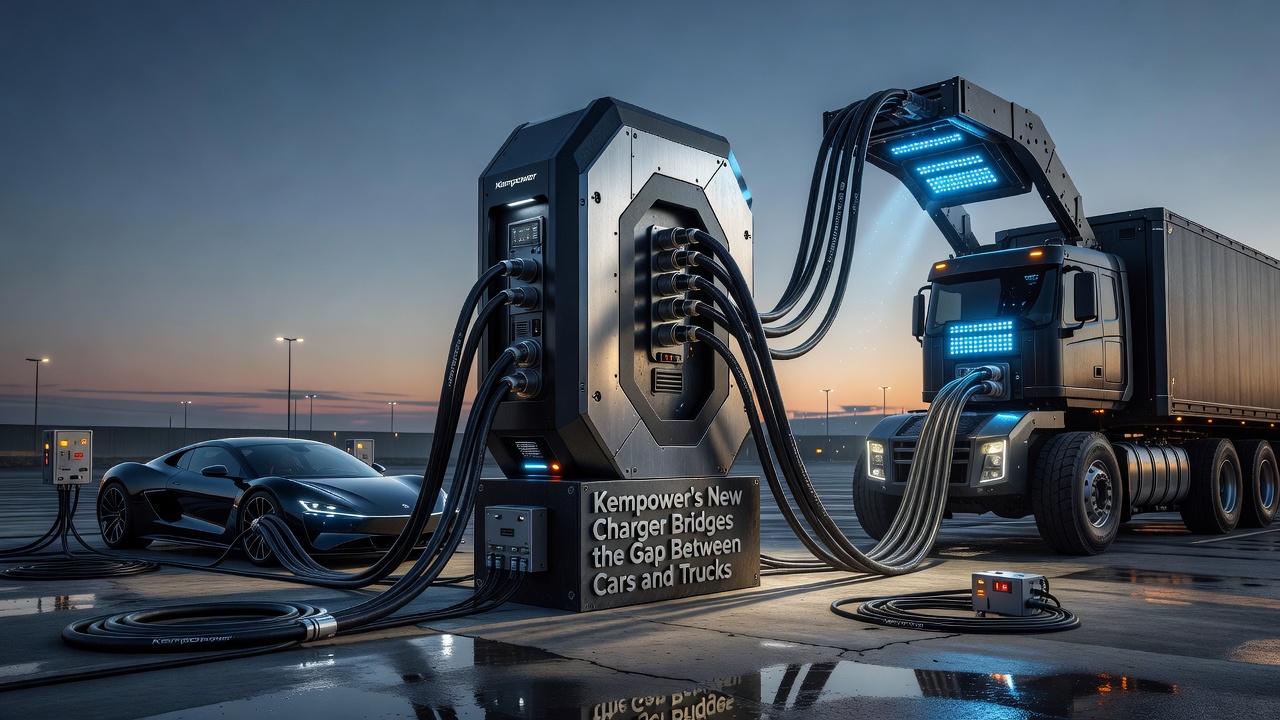
A single piece of hardware that can charge both a passenger sedan and a heavy-duty truck sounds simple, but it addresses one of the thorniest problems in electric transport infrastructure: the industry is running two charging standards at once, and nobody wants to build two separate networks to support them. Kempower's newly unveiled Mega Satellite Flex is designed to solve exactly that, combining support for the established Combined Charging System (CCS) with the emerging Megawatt Charging System (MCS) in one dispenser.
The unit delivers up to 560 kW through CCS and up to 1.2 MW through MCS, figures that reflect just how far apart the power needs of cars and trucks have become. Passenger EVs, even fast-charging 800-volt models, rarely draw more than a few hundred kilowatts. Heavy-duty trucks, hauling far greater loads over longer distances, need charging speeds an order of magnitude higher to make electric operation practical on tight schedules. For fleet operators and charging site developers comparing equipment costs against long-term returns, resources like current promotional pricing on related infrastructure services can factor into how quickly a mixed-use site pays for itself.
Why One Dispenser for Two Standards Matters
CCS has been the workhorse of passenger EV charging for years, built around power levels suited to consumer vehicles. MCS is newer, developed specifically because trucks require a fundamentally different power delivery architecture - higher voltage, higher current, and connectors engineered to handle both safely. Until now, operators building charging sites had to choose one standard or commit to installing separate hardware for each, doubling construction costs, permitting work, and grid connection upgrades.
The Mega Satellite Flex sidesteps that by supporting up to 1,500 amps on MCS and 700 amps on CCS from the same dispenser, with cable lengths of 5 meters for CCS and 2.7 meters for MCS. A site can open serving cars, trucks, or both, and adapt as demand shifts without a second buildout. That flexibility also extends to newer 800-volt passenger vehicles, which can pull higher charging speeds than older 400-volt platforms.
Utilization, Downtime, and the Economics of Charging Sites
Charging hardware is expensive, and unused capacity is the enemy of return on investment. A dispenser that only serves trucks, or only cars, sits idle whenever the other vehicle type shows up. By serving both from day one, Kempower's approach is meant to raise utilization rates immediately rather than waiting for truck traffic to justify a dedicated MCS installation later. Lower downtime and fewer idle hours translate directly into faster payback for site owners, a critical consideration as charging networks scale to meet freight electrification targets.
The Mega Satellite Flex also integrates with Kempower's existing distributed charging architecture, meaning operators already running Kempower systems can add the new dispenser without reconfiguring their power cabinets or software. An optional payment terminal rounds out the unit for public-facing sites.
What Comes Next
Kempower revealed the Mega Satellite Flex at its Unplug & Recharge event held alongside ACT Expo, where the charger remains on display this week. The company expects to bring it to market in North America and Europe in July 2026, giving fleet operators and infrastructure planners more than a year to factor the dual-standard approach into upcoming site designs as MCS adoption accelerates across the freight sector.